Monday, January 26, 2026

Military Commissions Media Invitation Announced for United States v. Abd al-Rahim al-Nashiri Pre-Trial Hearing

The Department of War invites media to cover pre-trial proceedings April 8 - 24, 2026 for Abd al-Rahim al-Nashiri, the defendant charged in the attack on the USS Cole (DDG 67).

The proceedings will take place at the Expeditionary Legal Complex located on Naval Station Guantanamo Bay (NSGB) Cuba and will be transmitted to a closed-circuit television (CCTV) site at Ft. Meade, Md.

Media may choose to travel to NSGB if agreeable to coverage windows outlined below and are willing to pay flight fees associated ($800 roundtrip); the hearing coverage windows are determined by the flight schedule. Specific ground rules for coverage at NSGB will follow registration.

The primary purpose of this invitation is to cover the military commissions. Tours of the detention facilities are not available. Requests for reporting on Guantanamo topics unrelated to the military commissions - such as the naval base facilities or personnel - must be coordinated in advance through the respective public officer with authority over those topics. OMC public affairs can provide point of contact information as needed.

Coverage windows, including travel*:

  • April 6 - 11
  • April 11 - 18
  • April 18 - 25

*Media may choose to stay more than one week.

Registration: Click here for registration and select the appropriate case and dates as outlined above.

Media on island attending the United States v. Encep Nurjaman hearing may be permitted to observe this hearing.

Deadline: All requests must be received no later than noon EST, Friday, Jan. 30. Additional details of travel preparations will be provided separately. By submitting the online request form, interested media will begin the travel process and respective OMC PAO will assist in travel preparations.

CCTV Site: Media choosing to view the hearing, from the media-designated viewing site at Fort Meade, Md., must send requests via email to osd.mc-alex.OMC.mbx.omc-pa@mail.mil with e-mail subject line matching the court case and the following information: name, position, news organization and contact information.

Contact Lt. Cmdr. Anthony Ivester, OMC Public Affairs, for additional questions at Anthony.j.ivester.mil@mail.mil or (571) 372-8934.

Case information can be viewed at the Office of Military Commissions website: https://www.mc.mil

Tuesday, January 20, 2026

Fearless Since 1962: How the SEALs Became the Navy's Most Elite Force

For decades, the Navy SEALs have been among the most recognized names of the U.S. military's elite warfighters. This month marks 64 years since the establishment of this storied force, which traces its roots back to the amphibious scouts, raiders and demolition units of World War II.

The SEALs — an acronym for sea, air and land — are the Navy's most well-known special operations force. They require some of the most grueling training in the world; only a fraction of those who try out for the notoriously difficult six-month Basic Underwater Demolition/SEAL training course finish it. After BUD/S, only those who graduate from SEAL qualification training are lucky enough to be awarded the coveted trident insignia and earn the Navy special warfare operator rating.

A scuba diver pushes a large black apparatus through deep blue water.

SEALs can gain access to hostile operational environments and undermine adversaries, according to the Naval Special Warfare Command, and they've protected American interests in nearly every major conflict of the past 80 years.

How It Began

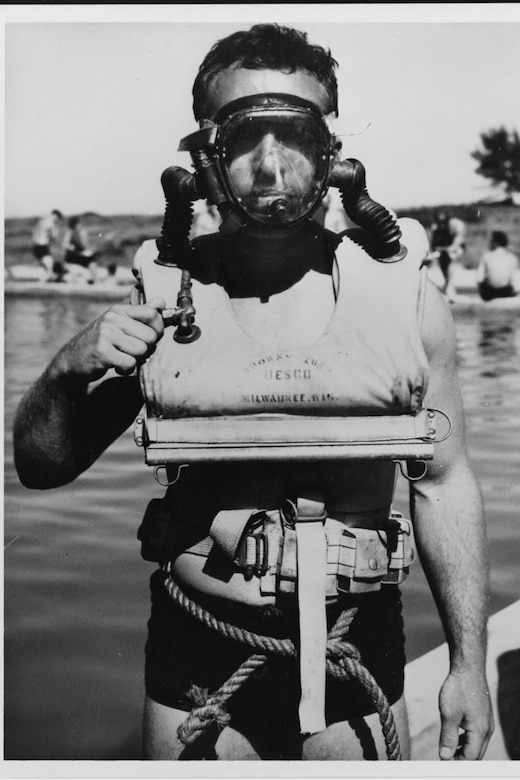
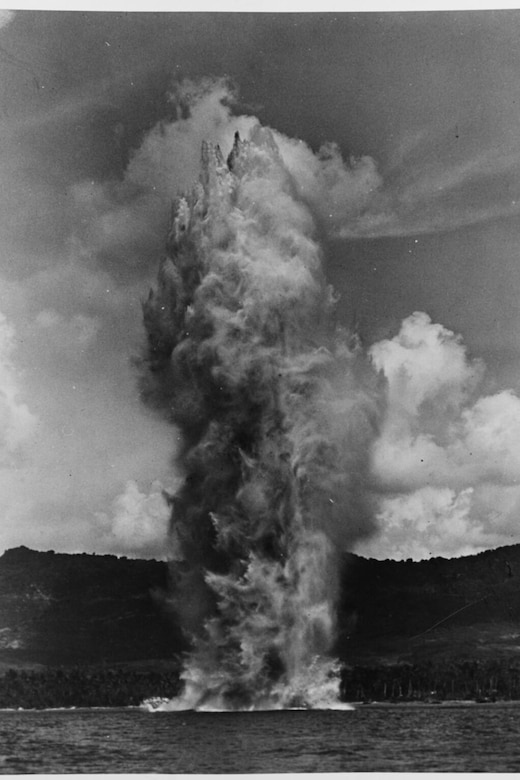
To understand the SEALs' origin, you have to go back to World War II, when the Army-Navy scouts and raiders, naval combat demolition units and underwater demolition teams were created. The scouts and raiders were trained particularly for amphibious reconnaissance ahead of the invasion of North Africa in November 1942, while the NCDU mission cleared landing zones for the European theater. The UDTs focused on similar missions in the Pacific because they were more knowledgeable on how to clear island-related obstacles, such as coral reefs, said Guy Nasuti, naval historian.

A man in a swimsuit, a face mask and other underwater equipment around his chest and waist poses for a photo.
A massive plume of water shoots up from the ocean near an island beach.
Demolition team recruits had to be intelligent, on-their-feet thinkers, in great shape and without fear. Many came from naval construction battalions, known as Seabees, who were the only sailors trained in that type of demolition at the time.

By the end of World War II, only the underwater demolition teams remained in existence. Many combat demolition unit personnel were absorbed into those teams after their mission in Europe concluded.

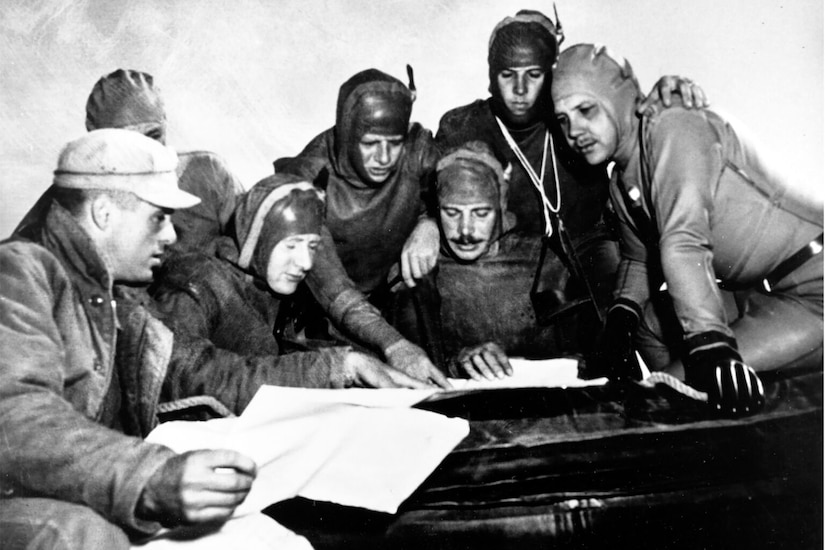
Within a few years, the UDTs were expanding their skillsets in Korea, conducting inland raids behind enemy lines, targeting railroad tunnels and bridges along the Korean coast and disrupting enemy movements. These operators, who earned the nickname "frogmen," took part in some major operations: the amphibious landings at Inchon, mine-clearing in North Korea's Wonsan harbor during an 861-day siege, and Operation Fishnet, which destroyed North Korea's vast fields of fishing nets, severely damaging one of the North's main economic industries.

Seven men, most of whom are in wetsuits and swim caps, gather together to look at a bunch of papers.
Five men in swim shorts and snorkels climb over rocks jutting into the ocean.
A New Focus, A New Name

By the late 1950s, minor conflicts between the U.S. and countries such as Laos and Cuba, including the Bay of Pigs invasion, led to the need for more forces across the services with special operations capabilities — units like the Army's Green Berets and the Marine Corps' force reconnaissance units.  But instead of expanding UDT missions further, Navy officials decided to create new units to focus on unconventional warfare, counter-guerrilla warfare and clandestine operations in maritime environments.

The SEALs emerged from those decisions. By January 1962, two SEAL teams were formally established, with personnel mostly drawn from preexisting UDTs, whose amphibious warfare skills remained highly sought-after. SEAL Team 1 was based at Naval Amphibious Base Coronado, California, while SEAL Team 2 was assigned to NAB Little Creek, Virginia.

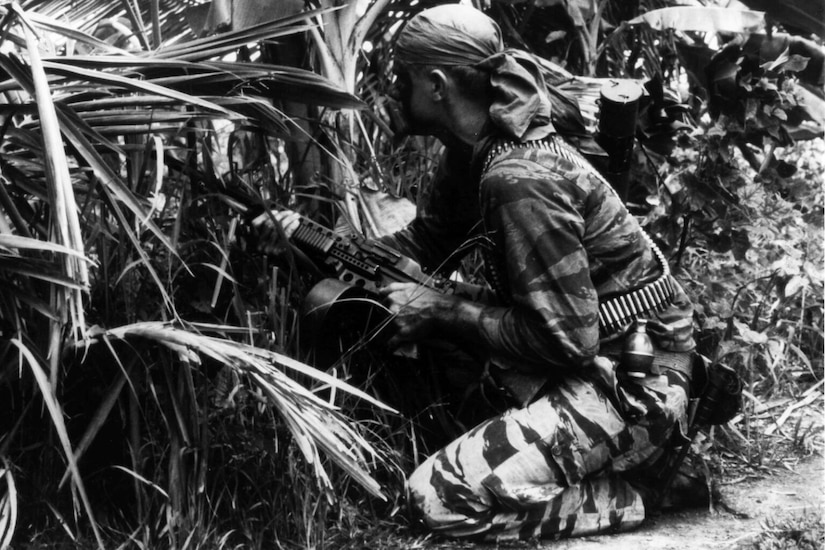
A man wearing a tiger-striped uniform and bandana holds onto an automatic weapon while crouching behind jungle plants.
Men in a camouflaged speed boat crouch low as they speed through a river.
Their existence, however, was highly classified, a fact that remained throughout most of the Vietnam War, where the SEALs mostly played an advisory role. They initially arrived in the country to teach South Vietnamese commandos their tactics. By 1966, however, they also helped carry out ambushes as well as conduct reconnaissance patrols and special intelligence operations via small, six-man teams.

Their presence grew throughout the war, as did their reputation for carrying out daring missions that were becoming increasingly necessary in the modern era of warfare. Between the Vietnam War and Sept. 11, 2001, the SEALs took part in missions in Grenada, Panama, Somalia, Bosnia, Haiti, Liberia and in the Persian Gulf, including during Operations Desert Shield/Desert Storm.

The SEALs had boots on the ground in Afghanistan within a month of the 9/11 attacks. During Operation Enduring Freedom, they carried out more than 75 special reconnaissance and direct-action missions while also operating in the Philippines and the Horn of Africa. Their most famous raid came on May 2, 2011, when SEAL Team 6 raided an al-Qaida compound in Abbottabad, Pakistan, killing Osama bin Laden, the mastermind behind the 9/11 attacks.

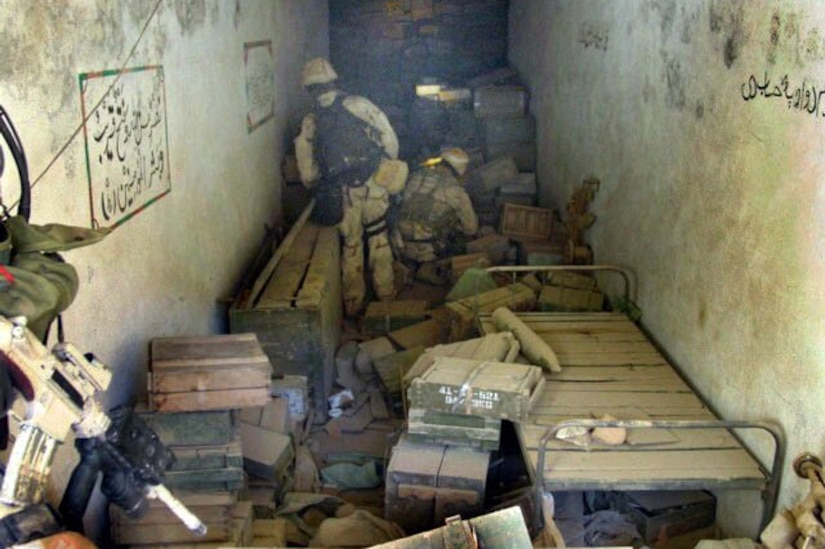
Two men in military camouflage uniforms look through a dingy concrete room filled with cots and boxes. Arabic writing is scrawled on the walls.
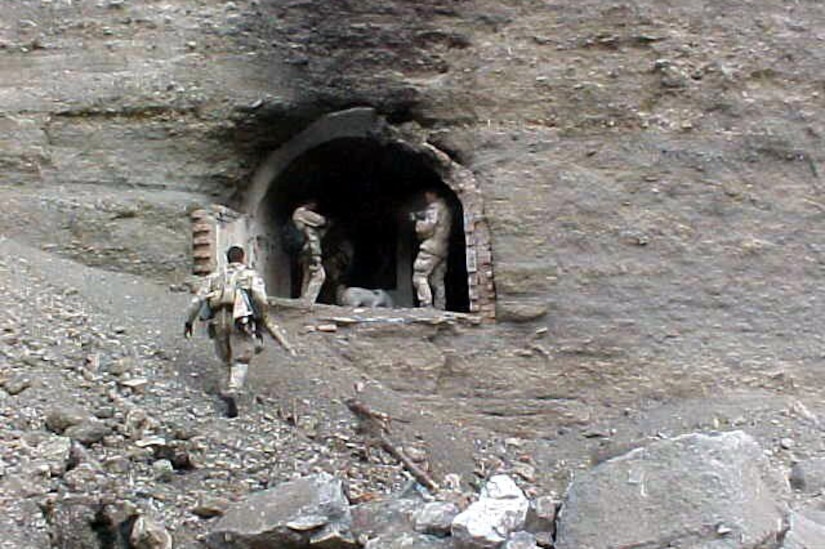
Three men in tactical military gear stand in the entrance to a rock cave.
Navy records show the largest SEAL deployment in history came during Operation Iraqi Freedom, when they captured or killed several high-value targets and raided sites suspected of having hazardous materials and weapons. The SEALs were vital to humanitarian aid missions and to securing oil infrastructure and offshore gas and oil terminals.

Notable SEALs

While most SEALs stay under the radar, a few have become well-known for their bravery and actions.

Capt. Phil Bucklew — known as the father of naval special warfare — ironically never qualified for BUD/S, but he had a storied career spanning decades. He began his service with the scouts and raiders in World War II and was involved in the invasions of North Africa and Normandy, France. He even went on a scouting mission in China to gather intelligence on the Japanese. In 1962, Bucklew was selected to command Naval Special Warfare Group 1, consisting of SEAL Team 1 and three other units. He was so respected in the community that, in 1987, the Naval Special Warfare Center in Coronado was named in his honor.

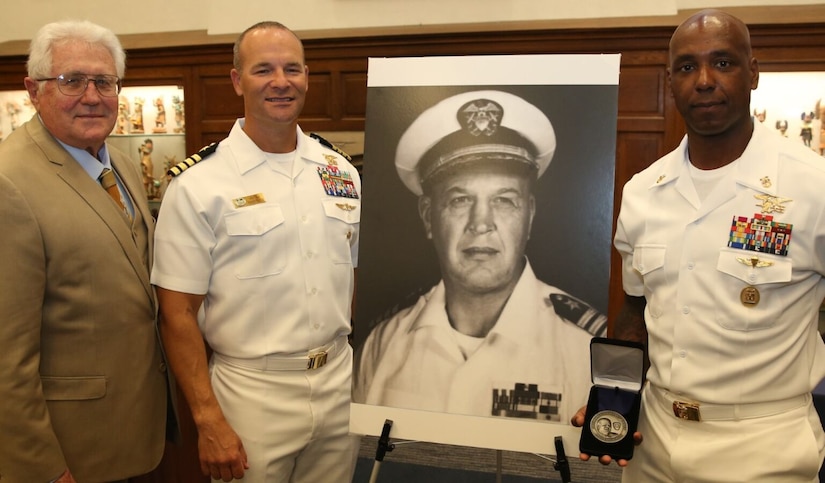
Two men in military dress uniforms and a man in a suit pose for a photo with a blown-up photo of a sailor wearing a dress uniform.

Retired Rear Adm. Thomas "The Hulk" Richards served with SEAL Team 1 in Vietnam in the early 1970s and received the Purple Heart and Bronze Star for his actions. Years later, he led SEAL Team 1 as its 13th commanding officer before finishing his 30-year career as the commander of Naval Special Warfare Command in the late 1990s.

Two Navy SEALs who served in Vietnam, Lt. j.g. Joseph Kerrey and Lt. Tom Norris, received Medals of Honor for their actions. Kerrey lost his leg during a raid that captured key Viet Cong political leaders and prevented a planned attack against U.S. ships. He went on to become the governor of Nebraska, a U.S. senator and a Democratic candidate for president in 1992.

When Norris couldn't become a pilot, he joined the SEALs. He was on his second tour of duty in Vietnam when he earned the Medal of Honor for leading a ground mission to rescue two downed pilots in enemy territory. Norris went on to become an FBI agent and was an original member of the agency's hostage rescue team.

Former SEAL Cmdr. William McRaven led several high-profile operations, notably the capture of Saddam Hussein and the rescue of Richard Phillips, the captain of the hijacked cargo ship Maersk Alabama, which inspired the Tom Hanks movie "Captain Phillips." He also developed and oversaw Operation Neptune Spear, which led to the death of bin Laden. That raid led to him becoming the runner-up for Time magazine's person of the year in 2011.

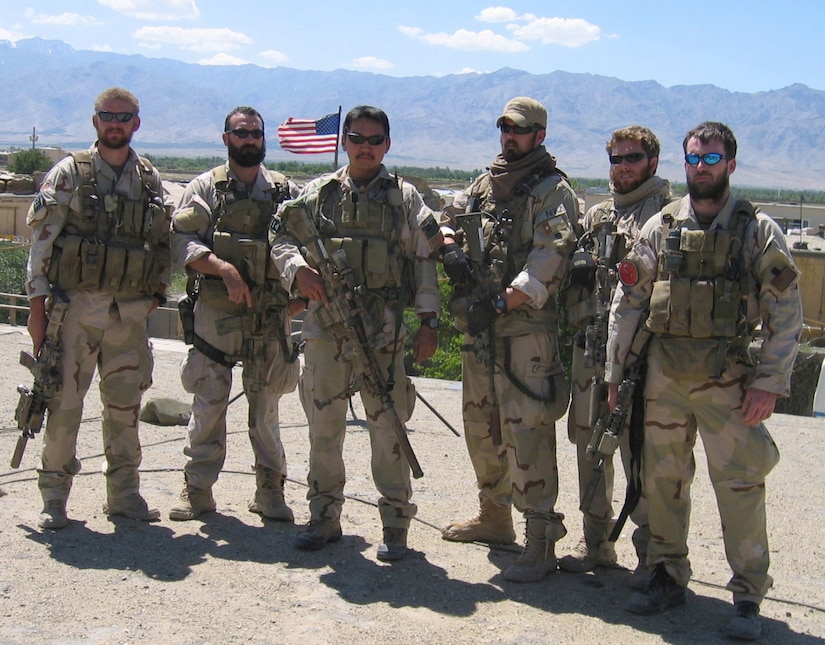
Six men wearing tactical camouflage military gear and carrying automatic weapons pose for a group photo in the desert. Mountains and an American flag fly behind them.

From Afghanistan, Lt. Michael Murphy and Petty Officer 1st Class Marcus Luttrell are often mentioned. During Operation Red Wings in 2005, the two men were on a small recon team looking for a high-level target in the Hindu Kush mountains when a horde of Taliban fighters ambushed them. Murphy, who led the team, didn't survive. He was, however, the first sailor to receive the Medal of Honor since Vietnam.

Luttrell, who was seriously injured, evaded capture by finding sympathetic locals who hid him in a nearby village for days until U.S. forces rescued him, all thanks to a rescue call that Murphy made before his death. Luttrell was the only man to survive the mission. His book about the ordeal, aptly named "Lone Survivor," was turned into a blockbuster movie.

Similarly, Chief Petty Officer Chris Kyle became the most lethal sniper in U.S. history during his four tours in Iraq. He wrote the book "American Sniper," which became a New York Times bestseller and was also turned into a hit movie. Sadly, about four years after his retirement, Kyle was killed by a fellow veteran with post-traumatic stress disorder whom he was trying to help. 

Monday, January 19, 2026

Narco-Terrorism: How Crime and Ideology Merged into a New Kind of War

Language does more than describe events; it creates categories that shape policy. Few terms show that more clearly than narco-terrorism. The word emerged to explain a specific kind of violence in Latin America, then expanded after 9/11 into a broader frame that links drug markets to insurgency and terrorism. Over time, its meaning has stretched so far that it now describes two different realities: traffickers using terror tactics to protect profits, and ideologically motivated groups using narcotics to finance political violence. That evolution matters, because the label narco-terrorism can trigger different legal tools, different public expectations, and different strategies for states trying to regain control.

What the word originally tried to capture

At its simplest, narco-terrorism combines two ideas: narcotics and terrorism. Early usage focused on terror-like violence used to influence government action connected to drug enforcement and trafficking. One influential overview traces the coinage to Peru in the early 1980s and notes that the term quickly became attached to political violence surrounding drugs and counterdrug policing (Hartelius, 2008). In this first phase, the concept was less about ideology and more about coercion: traffickers used fear, assassinations, and spectacular attacks to intimidate officials, deter extradition, or force policy concessions.

This framing also aligned with how counterdrug institutions talked about the problem. A DEA intelligence brief from 2002 described the historical association of “narco-terrorism” with Pablo Escobar and “terrorist tactics against noncombatants” used to protect the drug trade and pursue political aims tied to that trade (Drug Enforcement Administration, 2002). In other words, the earliest popular image was not a guerrilla movement selling drugs to buy weapons; it was a trafficker weaponizing terror methods to preserve a criminal enterprise.

The first major shift: from a tactic to a nexus

Over time, analysts began treating narco-terrorism less as a single tactic and more as a relationship between two problem sets: transnational narcotics trafficking and terrorism. A widely cited academic treatment argues that counterterrorism and counternarcotics increasingly found “common ground,” merging operational and conceptual frameworks in ways that blurred previously separate “wars” (Björnehed, 2004). This matters because it changes what the term is for. Instead of describing the behavior of one actor (a trafficker using terror), it becomes a way of describing a system: violent groups, illicit finance, governance gaps, and cross-border networks.

That broader “nexus” approach helps explain why the term remains contested. If narco-terrorism means “terrorism associated with the trade in illicit drugs,” it can cover a vast range of conduct, from small “taxation” of trafficking routes by insurgents to full-scale cartel campaigns aimed at breaking state authority (Hartelius, 2008). The wider the definition, the more tempting it becomes to use the label as a strategic shorthand, and the more likely it becomes to be applied inconsistently.

The post-9/11 expansion: narco-terrorism as financing and facilitation

After 9/11, the dominant security question shifted. States became intensely focused on how violent non-state actors fund operations, move people, and acquire weapons. In that environment, narcotics became less a regional criminal issue and more a global security concern. The term narco-terrorism gained new utility: it could describe cases where drug trafficking finances terrorism, or where terrorist organizations become involved in drug markets as part of their survival strategy (Björnehed, 2004; United Nations Office on Drugs and Crime, 2017).

UNODC’s analysis of links between drugs, organized crime, corruption, and terrorism/insurgency reflects this broadening: the “drug problem” is discussed not merely as crime, but as a driver that can intersect with insurgent and terrorist dynamics, especially where institutions are weak and illicit economies become a substitute for legitimate governance (United Nations Office on Drugs and Crime, 2017). In this framing, the drug trade becomes a strategic resource: it corrupts, recruits, destabilizes, and sustains armed organizations.

Codifying the concept: law turns “nexus” into an offense

When language moves into law, it becomes sharper and more consequential. In the United States, “narco-terrorism” is not only a descriptive label; it also refers to a specific statutory approach to drug trafficking connected to terrorism. Title 21 of the U.S. Code includes an offense (21 U.S.C. § 960a) aimed at trafficking that benefits terrorist activity or terrorism, requiring proof that the defendant knew the beneficiary had engaged in terrorism or terrorist activity (21 U.S.C. § 960a, n.d.).

This legal framing is important for two reasons. First, it pushes the definition toward the “drug trafficking that benefits terrorism” model, rather than the “traffickers using terror tactics” model. Second, it shows how governments can turn an elastic concept into a prosecutable theory with evidentiary requirements. The U.S. Sentencing Commission later created a guideline specifically because a § 960a offense differs from basic drug crimes in its terrorism linkage and the national security rationale behind punishment (U.S. Sentencing Commission, 2007). When narco-terrorism is treated as a terrorism-adjacent crime, the state’s response becomes heavier, faster, and more international in reach.

The contemporary convergence: cartels, insurgents, and hybrid actors

Today, the term is often invoked when criminal organizations adopt insurgent-like methods: propaganda, governance by fear, territorial control, and mass intimidation. But that is not identical to ideological terrorism. The modern environment features convergence. In some places, ideologically motivated groups tax or manage drug flows; in others, drug organizations use terror tactics as a business strategy; and in some cases, the two fuse into networks that are both political and commercial.

The “crime-terror continuum” lens helps explain why the boundaries blur. Björnehed’s analysis emphasizes that counterdrug and counterterror strategies can merge because the operational realities do: groups move along a spectrum where political violence, profit, and organized crime reinforce one another (Björnehed, 2004). UNODC similarly highlights how drugs and organized crime can erode governance, fuel corruption, and interact with conflict dynamics in ways that make clean labels harder to sustain (United Nations Office on Drugs and Crime, 2017).

The result is a definitional tension that hasn’t gone away: if a cartel uses terror tactics but has no ideological goal, is it “terrorism,” or is it coercive criminal violence at scale? If an insurgent movement relies on narcotics as a revenue engine, is it “narco-terrorism,” or simply insurgency funded by crime? The term persists because it captures a truth about modern conflict: illicit economies can be the lifeblood of political violence, and political violence can be a rational tool of market protection.

Why the evolution matters

Narco-terrorism is not just a word; it is a policy switch. Labels determine which agencies lead, which legal tools apply, what international cooperation looks like, and how the public understands legitimacy and threat. When the term is used narrowly, it points to a specific behavior: trafficking organizations employing terror tactics to compel state decisions (Drug Enforcement Administration, 2002; Hartelius, 2008). When used broadly, it names an ecosystem: the integration of drug revenue with violent political objectives and conflict (Björnehed, 2004; United Nations Office on Drugs and Crime, 2017). When codified legally, it becomes a prosecutorial and sentencing framework tied to terrorism knowledge and benefit, not merely intimidation (21 U.S.C. § 960a, n.d.; U.S. Sentencing Commission, 2007).

That range of meanings explains both the utility and the risk. The term can sharpen focus on real linkages between illicit markets and violent coercion. But if applied casually, it can flatten important distinctions between ideology-driven terrorism, insurgency, and high-violence organized crime. The most responsible use of the concept is therefore comparative and precise: specify which model is being used, what kind of actor is involved, and whether the “terror” element is ideology, method, or legal category.

Conclusion

Narco-terrorism began as an attempt to name a frightening reality: drug-linked violence so extreme it looked like terrorism. Over decades, the term expanded as states recognized that narcotics could finance and facilitate armed movements, and as terrorism and organized crime increasingly converged operationally. In law, the concept hardened into statutes and sentencing rules targeting trafficking that benefits terrorism. In policy discourse, it remains elastic because the world it describes is elastic: modern violent networks are often neither purely political nor purely criminal, but something in between. The term will keep evolving as long as illicit markets and political violence keep feeding each other—and as long as states need words that justify extraordinary tools to confront extraordinary threats.

References (APA)

Björnehed, E. (2004). Narco-terrorism: The merger of the war on drugs and the war on terror. Global Crime, 6(3–4), 305–324. https://www.diplomatie.gouv.fr/IMG/pdf/drogue-terreur.pdf

Drug Enforcement Administration. (2002, September). Drug Intelligence Brief: Narco-terrorism. https://loveman.sdsu.edu/supplement/docs/DEASeptember2002.pdf

Hartelius, J. (2008, February 20). Narcoterrorism. Swedish Defence Research Agency (FOI). https://www.files.ethz.ch/isn/90550/2008-02-20_Narcoterrorism.pdf

United Nations Office on Drugs and Crime. (2017). The drug problem and organized crime, illicit financial flows, corruption and terrorism/insurgency (World Drug Report 2017, Booklet 5). https://www.unodc.org/wdr2017/en/drug-problem.html

U.S. Sentencing Commission. (2007). Amendment 700 (creating §2D1.14 Narco-Terrorism related to 21 U.S.C. § 960a). https://www.ussc.gov/guidelines/amendment/700

United States Code. (n.d.). 21 U.S.C. § 960a: Foreign terrorist organizations, terrorists, and designated terrorist organizations. https://uscode.house.gov/view.xhtml?req=(title:21%20section:960a%20edition:prelim)

Saturday, January 17, 2026

Brian Cole Jr. Charged in Indictment in Planting Explosive Devices Outside the RNC and DNC on Jan. 5, 2021

WASHINGTON – Brian J. Cole, Jr., 30, of Woodbridge, Virginia, was charged in a federal indictment returned today in U.S. District Court in the planting of two improvised explosive devices (IEDs) on January 5, 2021, at the headquarters of both the Republican National Committee and the Democratic National Committee in Washington D.C., announced U.S. Attorney Jeanine Ferris Pirro.

The federal indictment, which supersedes a prior federal indictment returned during the holidays by a D.C. Superior Court grand jury, charges Cole with interstate transportation of explosives and with malicious attempt to use explosives.

Joining in the announcement were U.S. Attorney General Pamela Bondi, FBI Director Kash Patel, ATF Special Agent in Charge Anthony Spotswood of the Bureau of Alcohol, Tobacco, Firearms and Explosives, Washington Field Office, FBI Assistant Director in Charge Darren B. Cox of the Washington Field Office, and Interim Chief Jeffrey Carroll of the Metropolitan Police Department.

            “Given that Cole crossed state lines and targeted the political leadership of both parties for which there is an inherent crime of federal jurisdiction, handling this in federal court is most proper,” said U.S. Attorney Pirro. “The FBI and my office worked around the clock to ensure that this defendant is charged with the right crimes for his dangerous acts.”

On January 6, 2021, law enforcement discovered the IEDs near the DNC and RNC headquarters in Washington, D.C., both in close proximity to the U.S. Capitol. The same day Congress convened to certify the results of the 2020 election, and U.S. lawmakers were assembled nearby to carry out that constitutional duty.

Neither device detonated, and the U.S. Capitol Police were able to carry out a “render safe procedure” on the IEDs without incident. 

According to a complaint filed on Dec. 3, 2025, Cole purchased multiple components consistent with those used to manufacture the two IEDs during 2019 and 2020, at several retailers in northern Virginia.

At approximately 1 p.m. on Jan. 6, 2021, multiple law enforcement agencies received reports of a suspected IEDs near the headquarters of the RNC in Washington, D.C. About 1:15 p.m. the same day, a second suspected IED was reported just a few blocks away near the headquarters of the DNC.

Video surveillance determined that the same individual placed the devices on the evening of January 5, 2021. The suspect had been wearing dark pants, a grey hooded sweatshirt, dark gloves, Nike Air Max Speed Turf shoes, and a facemask that obscured the person’s face. The video showed the individual adjusting eyeglasses and carrying a backpack.

On January 5, 2021, about 7:10 p.m., Cole’s Nissan Sentra was observed driving past a License Plate Reader at the South Capitol Street exit from I-395 South, which is less than one-half mile from the location where the individual who placed the devices was first observed on foot near North Carolina and New Jersey Avenues, SE.

Cell phone records further show that Cole’s cell phone communicated with cell towers in the area of the RNC and DNC on January 5, 2021, between 7:39 p.m. and 8:24 p.m. The FBI’s Cellular Analysis and Survey Team determined that the location of Cole’s cell phone during this period corresponded with the path of the suspect identified by the FBI through analysis of video from that day.

This investigation is being conducted by the FBI Washington Field Office, the U.S. Capitol Police, the Bureau of Alcohol, Tobacco, Firearms and Explosives, the Metropolitan Police Department, and the U.S. Attorney’s Office for the District of Columbia. It is being prosecuted by the U.S. Attorney’s Office for the District of Columbia.

Madison Man Arrested for Arson of Beth Israel and the Goldring/Woldenberg Institute of Southern Jewish Life

Jackson, MS – A Madison man was arrested Saturday evening for charges related to his alleged arson of Beth Israel Congregation and the Goldring/Woldenberg Institute of Southern Jewish Life building. Attorney General Pamela Bondi, United States Attorney J.E. Baxter Kruger for the Southern District of Mississippi, and Special Agent in Charge Robert A. Eikhoff of the FBI Jackson Field Office made the announcement.

“This disgusting act of anti-Semitic violence has no place in our country, and unlike the prior administration, this Department of Justice will not let anti-Semitism fester and flourish,” said Attorney General Pam Bondi. “I have directed my prosecutors to seek severe penalties for this heinous act and remain deeply committed to protecting Jewish Americans from hatred.”

“Every American has a fundamental right to live and worship free from violence and fear,” said FBI Director Kash Patel. “The FBI will never waver in our mission to protect Jewish communities from targeted anti-Semitic attacks and will work to hold accountable anyone who engages in these types of violent acts.”

U.S. Attorney J.E. Baxter Kruger of the Southern District of Mississippi said, “This hateful, anti-Semitic attack on the Beth Israel Congregation is disturbing and unacceptable. Mississippians may rest assured that my office will not stand idly by when violence and intimidation threaten our community. We will seek the most serious charges warranted by the evidence and prosecute them to the fullest extent of the law. We remain fully committed to standing with Jewish Americans and protecting our communities from hatred and harm.”

Special Agent in Charge Robert A. Eikhoff of the FBI Jackson Field Office: "Houses of worship are sacred. Citizens of Mississippi of all faiths and backgrounds have the right to worship free of violence and intimidation. The heinous actions of Stephen Spencer Pittman, which allegedly sought to destroy the Beth Israel synagogue, will not be tolerated. While Mr. Pittman acted alone, FBI Jackson will continue to work with our federal, state, and local partners to hold accountable those who seek to infringe on the rights of Americans. The FBI is committed to protecting all places of worship and delivering justice for our communities. As always, we encourage the public to remain vigilant and to promptly report suspicious activities that could represent a threat to public safety."

According to court documents, Stephen Spencer Pittman, 19, of Madison, Mississippi, used gasoline to set fire to the religious building in the early morning hours of Saturday, January 10, 2026. The fire resulted in extensive damage to a significant portion of the building and rendered it inoperable for an indefinite period time, as can be seen in these photographs:

As a result of his crime, Pittman received burns to parts of his body.

According to its website, the Beth Israel Congregation was founded in 1860, and it has operated in its present location since 1967. On September 18, 1967, the then-new temple on Old Canton Road was bombed by the Ku Klux Klan. The Goldring/Woldenberg Institute of Southern Jewish Life provides services to Jewish communities in 14 states and comprehensive religious school programs to 70 Jewish congregations and offers traveling rabbinical services.

Pittman appeared in court today to face charges contained in a criminal complaint filed against him for violating Title 18, United States Code, Section 844(i), which prohibits arson of property used in interstate commerce or used in an activity affecting interstate commerce. If convicted, Pittman faces a minimum penalty of 5 years and a maximum penalty of 20 years imprisonment. A federal district court judge will determine any sentence after considering the U.S. Sentencing Guidelines and other statutory factors.

The FBI, the United States Bureau of Alcohol, Tobacco, Firearms, and Explosives, Jackson Police Department, and Jackson Fire Department are investigating the case.

Assistant U.S. Attorney Matt Allen is prosecuting the case.

This case is part of Operation Take Back America (https://www.justice.gov/dag/media/1393746/dl?inline) a nationwide initiative that marshals the full resources of the Department of Justice to repel the invasion of illegal immigration, achieve the total elimination of cartels and transnational criminal organizations (TCOs), and protect our communities from the perpetrators of violent crime. Operation Take Back America streamlines efforts and resources from the Department’s Organized Crime Drug Enforcement Task Forces (OCDETFs) and Project Safe Neighborhood (PSN).

A criminal complaint is merely an allegation and all defendants are presumed innocent until proven guilty beyond a reasonable doubt in a court of law.

Tuesday, January 13, 2026

Joint Interagency Task Force Announces First Replicator 2 Purchase to Counter Homeland Drone Threats

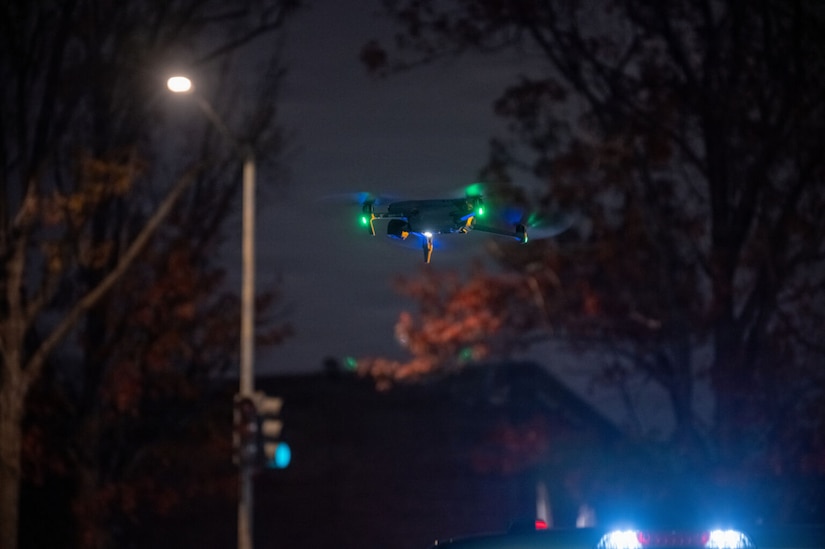
Joint Interagency Task Force 401 announced Jan. 11 its first acquisition under the Replicator 2 initiative, awarding a contract for two advanced DroneHunter F700 systems, which are expected to be delivered by April.

A small drone flies outside at night.

This acquisition provides the task force with enhanced capabilities to counter the growing threat posed by small unmanned aerial systems. It also marks a significant step in the War Department's strategy to rapidly field counter-unmanned aerial systems to protect military installations and critical infrastructure across the United States. 

"We're designed to move at the speed of relevance, cutting through red tape, consolidating resources, and engaging venture capitalists, tech startups, and nontraditional defense firms as critical partners," said Army Brig. Gen. Matt Ross, JIATF 401 director.

"We have just one measure of effectiveness: to deliver state-of-the-art counter-UAS capabilities to our warfighters both at home and abroad. This purchase of the DroneHunter system is a key first step in accomplishing our Replicator 2 mission," Ross added.

Replicator 2: A New Approach to Counter-UAS 

The Replicator initiative, first announced in August 2023, is a War Department effort to accelerate the delivery of innovative capabilities to the warfighter at speed and scale.  

While the first phase, Replicator 1, was focused on deploying thousands of autonomous systems across multiple domains, Replicator 2 is specifically aimed at countering the threat posed by small UAS.

A man in a camouflage military uniform stands in front of a wall of screens with maps on them as he talks to people in the foreground.

The joint task force, established in August 2025, is the lead organization for this effort, tasked with synchronizing counter-small UAS efforts across the department and rapidly delivering joint capabilities.  

"Replicator 2 is not about starting from scratch," Ross said. "It's about leveraging the incredible innovation happening in the commercial sector and getting it deployed where it is needed most."

The DroneHunter: A State-of-the-Art Solution 

The DroneHunter is a reusable, artificial intelligence-driven interceptor drone that provides a unique and effective solution to counter small UAS, especially in settings where personnel, infrastructure and surrounding activity require careful control of effects.  

The system uses AI and radar to detect and track small, low-altitude drones in complex environments. Once it spots a potential threat, the system can capture it with a tethered net.

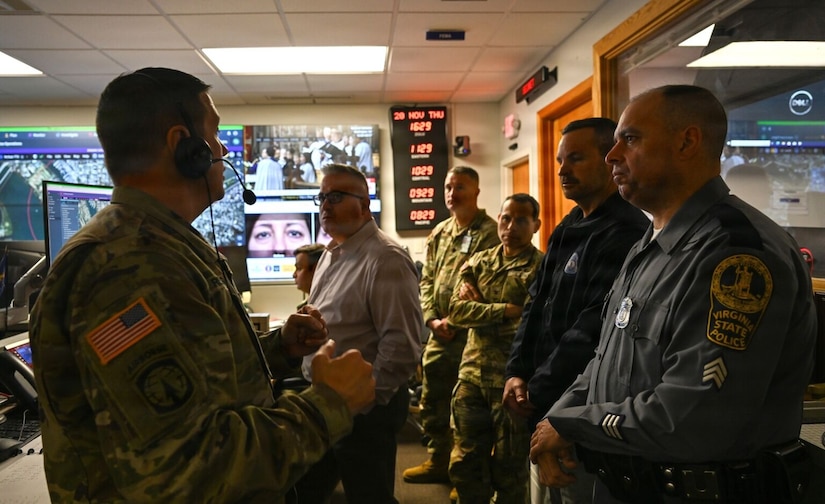
A man wearing a camouflage military uniform and headset speaks to several men in similar attire, police uniforms and business attire while in a government facility with large screens on the back wall.

The captured drone is then safely towed to a designated location for forensic analysis. This solution is ideal for use in the homeland, where the risk to civilian populations and infrastructure must be minimized. 

This initial purchase is the first step in the tailored approach the task force will take to deliver state-of-the-art counter-UAS technology to protect military infrastructure and service members.   

"This is one example that demonstrates how JIATF 401 has taken counter-drone efforts from a community of interest to a community of action," Ross said. "The task force is focused on a whole-of-government approach, working with interagency partners and industry to build a layered defense against the full spectrum of small UAS threats to the homeland."

Friday, December 26, 2025

Religious Sites as Targets: The Strategic Significance of Terrorism Against Places of Worship

Terrorist violence is never random. Even when an attack appears impulsive or opportunistic, the selection of a target reflects a strategic calculation. In recent days, renewed attacks against places of worship—mosques, synagogues, and churches—have once again demonstrated a grim pattern: extremists consistently choose sacred spaces not merely for casualties, but for symbolism. These acts are designed to fracture social trust, provoke sectarian fear, and transform houses of peace into theaters of terror.

This pattern is neither new nor accidental. From the 2019 Christchurch mosque attacks in New Zealand to synagogue shootings in the United States, church bombings in Africa, and mosque attacks in the Middle East, places of worship have become among the most psychologically potent targets available to violent extremists. Understanding why requires examining not only tactics, but meaning.


Sacred Space and Symbolic Violence

Places of worship occupy a unique position in human societies. They are not merely buildings; they represent moral order, communal identity, continuity, and transcendence. For believers, these spaces are sanctified by ritual, memory, and covenant. For terrorists, that sanctity is precisely the point.

Violence in a sacred space carries an amplified message. It declares that no place is beyond reach, no value is protected, and no refuge is secure. Unlike attacks on infrastructure or military targets, attacks on religious institutions strike at the psychological foundations of community life. The goal is not just death, but desecration.

Extremist ideologies—whether religious, ethno-nationalist, or political—often frame themselves as purifying forces. Targeting a place of worship allows attackers to redefine sacredness on their own terms, asserting dominance over what a society holds inviolable. In this sense, terrorism against religious sites is a form of symbolic warfare, aimed at rewriting moral boundaries through fear.


Soft Targets, Hard Consequences

From an operational standpoint, places of worship are often “soft targets.” They are designed to be open, welcoming, and accessible. Security measures are typically limited, especially during regular services. This openness, essential to religious practice, creates vulnerabilities that extremists exploit.

Yet the consequences extend far beyond the immediate victims. Attacks on religious sites reverberate across entire societies. They provoke retaliatory violence, deepen existing divisions, and invite cycles of grievance that extremists rely on for recruitment and justification.

Research in terrorism studies consistently shows that attacks targeting civilians in symbolic spaces increase media attention and emotional response, even when casualty counts are lower than those of large-scale bombings. The spectacle matters. Terrorists understand that fear spreads faster than ideology, and sacred spaces magnify that fear.


Sectarianism as a Force Multiplier

In regions already marked by religious or ethnic tension, attacks on places of worship function as accelerants. A bombing of a mosque or synagogue is rarely intended to end with the initial act. It is meant to provoke reprisals, confirm narratives of persecution, and polarize populations into mutually hostile camps.

This strategy has been employed by groups such as ISIS, which deliberately targeted Shi’a mosques to inflame Sunni–Shi’a conflict, destabilize governments, and position itself as a defender of a “true” faith. Similar dynamics are visible in attacks driven by white supremacist ideology, where violence against synagogues or churches is framed as resistance to imagined cultural threats.

In each case, the place of worship becomes a proxy battlefield. The physical damage is real, but the deeper objective is social fragmentation.


Western Democracies and the Illusion of Distance

For much of the early 21st century, attacks on religious sites were often framed as distant tragedies—problems of the Middle East, South Asia, or Africa. That illusion has long since collapsed. The United States and Europe have witnessed repeated attacks on churches, synagogues, and mosques, carried out by individuals radicalized online, inspired by transnational ideologies, or motivated by domestic grievances reframed as existential threats.

These incidents reveal a critical challenge for liberal democracies: how to protect open societies without transforming sacred spaces into fortified zones. Heavy security can deter attackers, but it also risks altering the very character of religious life, reinforcing the sense that fear has won.

The dilemma is not merely tactical. It is philosophical. Terrorism against places of worship forces societies to confront questions about pluralism, tolerance, and the limits of openness in an age of ideological violence.


Leadership, Responsibility, and Prevention

Preventing attacks on religious sites requires more than armed guards and surveillance cameras. It demands leadership—moral, civic, and institutional. Community leaders, faith organizations, and governments must work collaboratively to address both immediate security needs and the deeper drivers of radicalization.

This includes early intervention programs, interfaith dialogue grounded in realism rather than symbolism alone, and clear legal frameworks that balance civil liberties with public safety. It also requires honest recognition that extremist violence often feeds on grievance narratives that thrive in environments of social isolation and mistrust.

Importantly, leaders must resist the temptation to respond with rhetoric that mirrors extremist logic. Collective blame, inflammatory language, and political opportunism all serve the objectives of those who seek division. The defense of sacred spaces is inseparable from the defense of democratic values.


Why This Pattern Endures

Terrorism against places of worship persists because it works—at least in the short term. It commands attention, destabilizes communities, and forces societies into reactive postures. But history also shows that such violence ultimately fails to achieve its broader aims.

Communities rebuild. Faith endures. The symbolic power terrorists seek to exploit often rebounds against them, strengthening solidarity rather than destroying it. Yet this outcome is not automatic. It depends on how societies respond—whether they retreat into fear or reaffirm shared values under pressure.

Understanding why religious sites are targeted is therefore not an academic exercise. It is a prerequisite for resilience.


Conclusion

Attacks on places of worship are among the most morally corrosive forms of terrorism. They exploit humanity’s deepest instincts—faith, belonging, reverence—and attempt to weaponize them against the societies that cherish them. These acts are designed not only to kill, but to desecrate, divide, and intimidate.

Recognizing the strategic logic behind such attacks allows communities and leaders to respond with clarity rather than panic, resolve rather than rage. Sacred spaces will always be vulnerable precisely because they are sacred. The challenge is not to abandon openness, but to defend it wisely.

In the end, the measure of a society is not whether it can prevent every act of violence, but whether it can preserve its moral architecture when that violence occurs. Terrorists target places of worship because they understand what those places represent. The response must prove them wrong about what can be destroyed.


References Al Qaeda. (2005).

Hoffman, B. (2017). Inside terrorism (2nd ed.). Columbia University Press.

Pape, R. A. (2005). Dying to win: The strategic logic of suicide terrorism. Random House.

United Nations Office of Counter-Terrorism. (2021). Protection of religious sites: Enhancing security and fostering resilience. United Nations.

Weinberg, L., Pedahzur, A., & Hirsch-Hoefler, S. (2004). The challenges of conceptualizing terrorism. Terrorism and Political Violence, 16(4), 777–794.

Monday, December 22, 2025

Preventing the Next Generation of Terrorism: Lessons History Keeps Teaching Us

Terrorism is often treated as a sudden rupture in social order—an eruption of violence that demands immediate suppression. Yet history shows that terrorism is rarely spontaneous. It is learned, inherited, and refined across generations. Each era encounters what it believes to be a novel threat, but the underlying dynamics of political violence remain strikingly consistent. Preventing the next generation of terrorism therefore requires more than improved surveillance or military capability; it requires an honest reckoning with historical patterns that societies repeatedly ignore.

One of the most persistent lessons is that terrorism is a social process before it is a security problem. Studies of extremist movements across the twentieth and twenty-first centuries demonstrate that radicalization develops through narratives of grievance, identity, and moral justification rather than through ideology alone. Individuals are rarely drawn to violence by doctrine in isolation; they are drawn by stories that explain personal or collective suffering and assign blame in morally absolute terms. Terrorist organizations survive not because they win militarily, but because they transmit these narratives effectively across time, adapting their language to new audiences while preserving core myths of victimhood and redemption. When counterterrorism strategies focus solely on eliminating leaders or dismantling cells, they often leave these narratives intact, allowing new adherents to emerge under different banners.

History also reveals the limitations of purely military solutions. Tactical victories against terrorist groups have repeatedly failed to produce lasting security when they are not accompanied by political legitimacy and social repair. In cases ranging from colonial-era insurgencies to modern counterterrorism campaigns, the use of overwhelming force has frequently reduced immediate violence while increasing long-term resentment. Civilian casualties, collective punishment, and indefinite emergency measures tend to validate extremist claims that peaceful participation is futile. This does not imply that force is unnecessary; rather, it underscores that force alone cannot resolve a phenomenon rooted in social meaning and political trust.

Modern radicalization pathways further complicate prevention efforts. Historically, extremist recruitment occurred through face-to-face relationships embedded in local communities. Today, digital platforms allow individuals to radicalize in isolation, consuming curated grievance narratives without direct organizational contact. Research indicates that online environments accelerate moral polarization by rewarding outrage, simplifying complex conflicts, and reinforcing identity-based hostility. Prevention therefore must occur earlier and more subtly than traditional security models allow. By the time an individual appears on the radar of law enforcement, the underlying process has often been underway for years.

Communities play a decisive role in interrupting this process. Historical evidence consistently shows that strong social bonds, credible local leadership, and inclusive civic institutions reduce susceptibility to extremist recruitment. When communities trust public institutions and feel represented within them, extremist narratives lose plausibility. Conversely, when communities are treated primarily as security risks rather than as partners, alienation deepens and informal social controls weaken. Prevention efforts that succeed tend to be those that enhance community resilience rather than impose external control.

Another lesson history teaches is that terrorism competes in a marketplace of meaning. Extremist movements offer their adherents identity, purpose, and moral certainty—often in contexts where legitimate avenues for meaning appear absent or discredited. Education alone has not proven sufficient to counter this appeal. While economic opportunity and civic education are important, they must be paired with credible moral frameworks that acknowledge grievance without sanctifying violence. Societies that neglect this struggle over meaning leave space for absolutist ideologies to fill the void.

Leadership and moral consistency are equally critical. Historical case studies demonstrate that counterterrorism efforts lose credibility when states abandon their professed values under pressure. Torture, indefinite detention, and extrajudicial practices may produce short-term intelligence gains, but they undermine the moral authority necessary for long-term prevention. Extremist movements thrive on examples of hypocrisy, using them to reinforce narratives of injustice and persecution. Leaders who model restraint, accountability, and proportionality during crises help deny future extremists the moral ammunition they seek.

Perhaps the most uncomfortable lesson is that the persistence of terrorism reflects not ignorance, but avoidance. The historical record clearly documents what fuels extremist violence and what mitigates it. Yet prevention strategies often clash with political incentives that favor immediate, visible action over long-term investment. Addressing radicalization requires patience, humility, and a willingness to confront social failures that are politically inconvenient. As a result, societies repeatedly default to reactive measures, rediscovering the same lessons after each new attack.

Preventing the next generation of terrorism ultimately means acting before the phenomenon has a name, a leader, or a flag. It requires viewing terrorism not as an external infection, but as a byproduct of unresolved grievances, fractured identities, and eroded trust. History does not suggest that terrorism can be eliminated entirely, but it does make clear that its appeal can be narrowed. The question is not whether the lessons are available, but whether societies are willing to apply them consistently, even when fear and anger make restraint difficult.

References

Crenshaw, M. (1981). The causes of terrorism. Comparative Politics, 13(4), 379–399.

Horgan, J. (2008). From profiles to pathways and roots to routes: Perspectives from psychology on radicalization into terrorism. The Annals of the American Academy of Political and Social Science, 618(1), 80–94.

Kydd, A. H., & Walter, B. F. (2006). The strategies of terrorism. International Security, 31(1), 49–80.

Neumann, P. R. (2013). The trouble with radicalization. International Affairs, 89(4), 873–893.

Pape, R. A. (2005). Dying to win: The strategic logic of suicide terrorism. Random House.